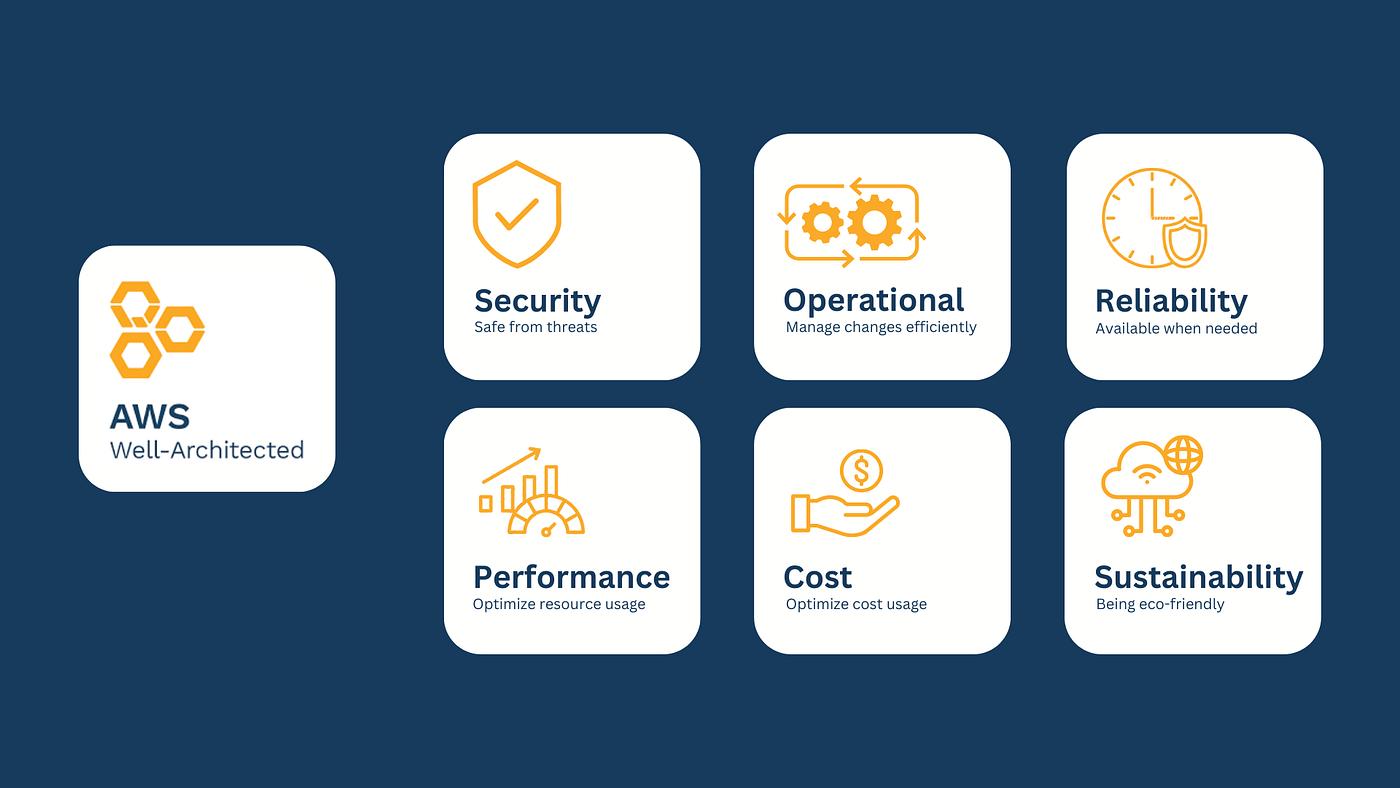
The AWS Well-Architected Framework is a set of best practices and guidelines that help cloud architects build secure, high-performing, resilient, and efficient infrastructure for their applications. It provides a consistent approach for evaluating architectures and implementing designs that can scale over time.
The Six Pillars of Well-Architected Framework
The framework consists of six pillars, each representing a fundamental area of cloud architecture:
Operational Excellence
Run and monitor systems to deliver business value and continuously improve supporting processes and procedures.
Security
Protect information, systems, and assets while delivering business value through risk assessments and mitigation strategies.
Reliability
Prevent and quickly recover from failures to meet business and customer expectations.
Performance Efficiency
Use IT and computing resources efficiently to meet system requirements and maintain efficiency as demand changes.
Cost Optimization
Deliver business value at the lowest price point by eliminating waste and optimizing resources.
Sustainability
Minimize the environmental impact of running cloud workloads by optimizing energy consumption and resource usage.
Pillar 1: Operational Excellence
Operational Excellence focuses on running and monitoring systems to deliver business value and continuously improve processes.
Key Design Principles
- Perform operations as code: Use infrastructure as code and automate operations
- Make frequent, small, reversible changes: Reduce change risk
- Refine operations procedures frequently: Continuously improve
- Anticipate failure: Implement failure response mechanisms
- Learn from all operational failures: Conduct post-incident reviews
Best Practices
- ✅ Use AWS CloudFormation or Terraform for infrastructure as code
- ✅ Implement CI/CD pipelines with AWS CodePipeline
- ✅ Use AWS CloudWatch for monitoring and alerting
- ✅ Conduct regular operational readiness reviews
- ✅ Implement runbooks and playbooks for incident response
Pillar 2: Security
Security focuses on protecting information, systems, and assets while delivering business value.
Key Design Principles
- Implement a strong identity foundation: Use least privilege access
- Enable traceability: Monitor and log all actions
- Apply security at all layers: Defense in depth
- Automate security best practices: Use automated tools
- Protect data in transit and at rest: Encryption everywhere
Best Practices
- ✅ Enable AWS CloudTrail and AWS Config in all regions
- ✅ Implement AWS Security Hub for centralized security management
- ✅ Use AWS WAF and AWS Shield for application protection
- ✅ Encrypt data at rest and in transit
- ✅ Implement AWS IAM with least privilege access
Pillar 3: Reliability
Reliability focuses on preventing failures and quickly recovering from them to meet business and customer expectations.
Key Design Principles
- Automatically recover from failure: Implement self-healing
- Scale horizontally to increase aggregate availability: Use distributed systems
- Stop guessing capacity: Use auto-scaling
- Manage change in automation: Use infrastructure as code
- Test recovery procedures: Regularly test DR plans
Best Practices
- ✅ Deploy applications across multiple Availability Zones
- ✅ Use AWS Auto Scaling for capacity management
- ✅ Implement AWS Backup for data protection
- ✅ Use AWS Elastic Load Balancing for traffic distribution
- ✅ Set up Amazon Route 53 health checks and failover
Pillar 4: Performance Efficiency
Performance Efficiency focuses on using IT and computing resources efficiently to meet system requirements.
Key Design Principles
- Democratize advanced technologies: Use managed services
- Go global in minutes: Deploy globally with ease
- Use serverless architectures: Reduce operational overhead
- Experiment more often: Use data-driven decisions
- Mechanical sympathy: Understand infrastructure performance
Best Practices
- ✅ Use AWS Compute Optimizer for instance recommendations
- ✅ Implement Amazon CloudFront for content delivery
- ✅ Use AWS Lambda for serverless compute
- ✅ Leverage AWS Graviton instances for ARM workloads
- ✅ Use Amazon RDS Performance Insights for database optimization
Pillar 5: Cost Optimization
Cost Optimization focuses on delivering business value at the lowest price point.
Key Design Principles
- Adopt a consumption model: Pay only for what you use
- Measure overall efficiency: Track cost per user or transaction
- Stop spending on data center operations: Use managed services
- Analyze and attribute expenditure: Use tagging and cost allocation
- Use managed and application-level services: Reduce operational overhead
Best Practices
- ✅ Use AWS Cost Explorer for cost analysis
- ✅ Implement AWS Budgets for cost alerts
- ✅ Use AWS Savings Plans and Reserved Instances
- ✅ Implement S3 Lifecycle policies for storage optimization
- ✅ Use AWS Trusted Advisor for cost optimization recommendations
Pillar 6: Sustainability
Sustainability focuses on minimizing the environmental impact of running cloud workloads.
Key Design Principles
- Understand your impact: Measure carbon emissions
- Maximize utilization: Right-size resources
- Choose efficient hardware: Use energy-efficient instances
- Optimize for reduced energy consumption: Efficient architectures
- Reduce waste: Eliminate idle resources
Best Practices
- ✅ Use AWS Graviton processors for lower energy consumption
- ✅ Implement serverless architectures to reduce idle resources
- ✅ Use AWS Cost Explorer for carbon footprint tracking
- ✅ Right-size resources to avoid over-provisioning
- ✅ Implement automated shutdown of non-production resources
Well-Architected Review Process
Conducting a Well-Architected Review helps identify gaps and improve your architecture:
- Prepare: Gather documentation and architecture diagrams
- Review: Assess your workload against the six pillars
- Identify: Document risks and improvement opportunities
- Prioritize: Address high-impact improvements first
- Implement: Execute the remediation plan
- Repeat: Conduct regular reviews as workloads evolve
At DeployInCloud, we help enterprises implement the AWS Well-Architected Framework. Contact us for a free Well-Architected Review today.