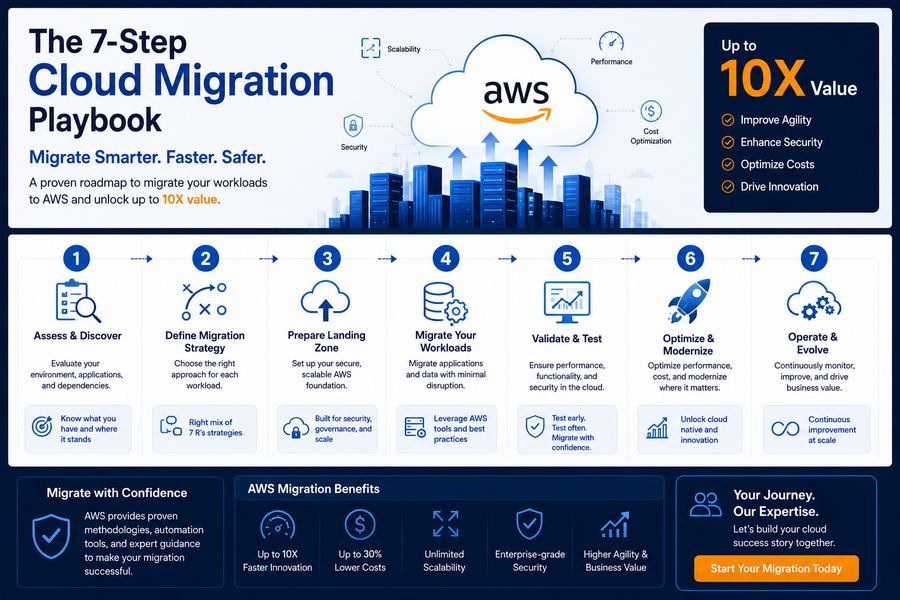
Cloud migration is the process of moving digital assets—such as data, applications, and IT resources—from on-premise infrastructure to cloud environments. With the right framework, organizations can achieve a seamless transition with minimal business disruption.
At DeployInCloud, we've developed a proven 7-step migration framework based on 500+ successful enterprise migrations. This framework has been refined over years of experience and is designed to ensure zero downtime, minimal risk, and optimal performance.
Step 1: Discovery & Assessment
Discover and analyze your current infrastructure
We analyze your current infrastructure, applications, and workloads to create a comprehensive migration strategy.
Key Activities:
- Application discovery and dependency mapping
- Infrastructure inventory and assessment
- Performance baseline establishment
- Security and compliance review
Step 2: Migration Planning
Create a detailed migration plan
Detailed migration plan including timeline, resource allocation, risk assessment, and rollback strategies.
Key Activities:
- Define migration strategy (Lift & Shift, Replatform, Refactor)
- Create timeline and milestones
- Resource planning and allocation
- Risk assessment and mitigation planning
Step 3: Infrastructure Setup
Provision cloud infrastructure
Provision cloud infrastructure with best practices for security, networking, and compliance.
Key Activities:
- VPC and subnet configuration
- Security groups and NACL setup
- IAM roles and policies
- Network connectivity (VPN/Direct Connect)
Step 4: Data Replication
Real-time data replication to cloud
Real-time data replication from on-premise to cloud using AWS DMS and other migration tools.
Key Activities:
- Database migration and replication
- File and object data transfer
- Continuous data synchronization
- Data validation and verification
Step 5: Testing & Validation
Comprehensive testing of migrated workloads
Comprehensive testing of migrated workloads to ensure performance, security, and functionality.
Key Activities:
- Functional testing of applications
- Performance and load testing
- Security testing and vulnerability scanning
- User acceptance testing (UAT)
Step 6: Cutover & Migration
Zero-downtime cutover to the cloud
Zero-downtime cutover to the cloud with automated rollback capabilities.
Key Activities:
- Final data synchronization
- DNS and routing changes
- Application cutover and validation
- Rollback plan execution (if needed)
Step 7: Post-Migration Optimization
Optimize performance, costs, and security
Optimize performance, costs, and security with ongoing monitoring and improvement.
Key Activities:
- Performance monitoring and tuning
- Cost optimization and FinOps
- Security review and compliance
- Documentation and knowledge transfer
✅ Migration Checklist
- ✅ Complete discovery of all applications and dependencies
- ✅ Define clear migration strategy and timeline
- ✅ Set up cloud infrastructure with security best practices
- ✅ Establish data replication and synchronization
- ✅ Conduct comprehensive testing of migrated workloads
- ✅ Execute zero-downtime cutover with rollback plan
- ✅ Monitor performance and optimize post-migration
- ✅ Document and train teams on cloud operations
At DeployInCloud, we've helped 500+ enterprises migrate to the cloud using this proven framework. Contact us for a free migration assessment today.