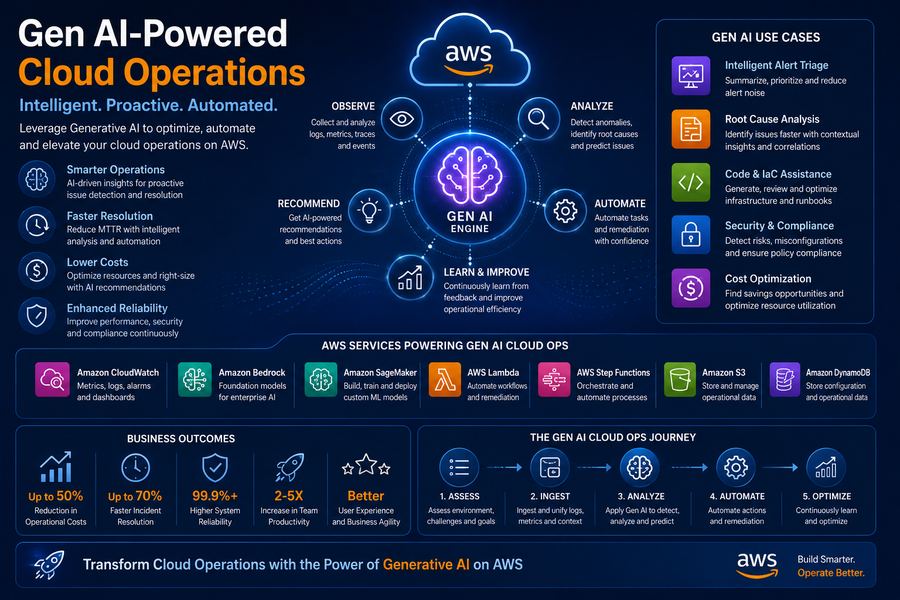
Generative AI is revolutionizing cloud operations by enabling intelligent automation, predictive analytics, and natural language interaction with cloud infrastructure. Organizations are leveraging Gen AI to transform how they manage, monitor, and optimize their cloud environments.
What is Generative AI?
Generative AI refers to artificial intelligence systems that can generate new content, insights, and solutions based on training data. In cloud operations, Gen AI can analyze vast amounts of operational data, generate insights, and automate complex tasks.
Key Capabilities:
- Natural Language Processing: Understand and respond to human language
- Pattern Recognition: Identify anomalies and patterns in data
- Content Generation: Create documentation, reports, and code
- Intelligent Automation: Automate complex decision-making processes
Key Use Cases in Cloud Operations
AI-Powered Support Chatbots
Intelligent chatbots that understand complex cloud infrastructure issues and provide instant solutions to engineering teams.
Log Analysis & Root Cause
Automated log analysis to identify root causes of incidents and provide actionable recommendations.
Security Threat Detection
Real-time security threat detection with natural language alerts and automated response recommendations.
Cost Optimization Insights
AI-generated insights for optimizing cloud costs with actionable recommendations and forecasts.
Infrastructure as Code Generation
Generate Terraform and CloudFormation templates from natural language descriptions.
Automated Documentation
Generate and maintain cloud architecture documentation automatically.
Large Language Models (LLMs)
LLMs are at the heart of Gen AI applications in cloud operations. Here are the key models being used:
Implementation Strategy
Step 1: Define Use Cases
Identify specific cloud operations challenges that Gen AI can address. Start with high-impact, low-complexity use cases.
Step 2: Choose the Right Model
- Evaluate LLM options (OpenAI, Anthropic, AWS Bedrock)
- Consider security, compliance, and cost
- Test with your specific cloud data
Step 3: Data Preparation
- Collect and clean cloud operational data
- Create training datasets for fine-tuning
- Implement data governance and security
Step 4: Integration
- Integrate Gen AI with existing cloud tools
- Build APIs and interfaces
- Implement monitoring and feedback loops
Step 5: Deployment & Monitoring
- Deploy in staging and test thoroughly
- Monitor performance and accuracy
- Iterate and improve based on feedback
Challenges and Considerations
Data Privacy & Security
Ensure sensitive cloud data is protected and compliance requirements are met when using LLMs.
Accuracy and Hallucination
LLMs can generate incorrect information. Implement validation and human review processes.
Cost Management
LLM usage can be expensive. Monitor costs and optimize prompts to reduce token usage.
Integration Complexity
Integrating Gen AI with existing cloud operations tools requires careful planning and architecture design.
Case Study: AI-Powered Cloud Operations
Company: Global Tech Enterprise
Challenge: 200+ engineers spending 30% of time on operational tasks and incident response
Solution: Implemented Gen AI assistant using AWS Bedrock for cloud operations
Results:
- ✅ 50% reduction in incident response time
- ✅ 40% reduction in manual operational tasks
- ✅ $2M annual savings in operational costs
- ✅ 95% accuracy in root cause analysis
At DeployInCloud, we help enterprises implement Gen AI solutions for cloud operations. Contact us for a free AI assessment today.