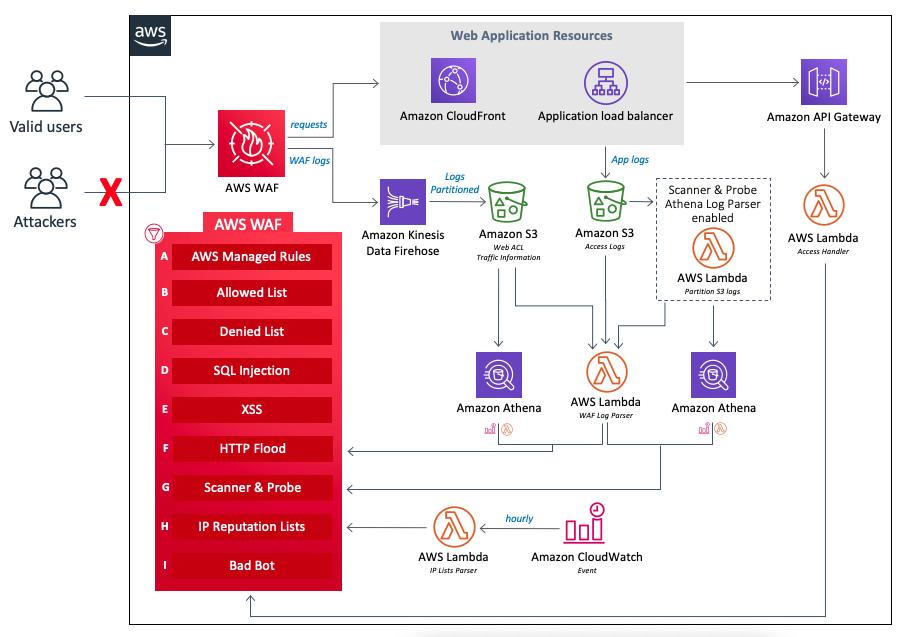
AWS Web Application Firewall (WAF) is a managed security service that protects your web applications from common web exploits and vulnerabilities. It helps you protect against attacks like SQL injection, cross-site scripting (XSS), and distributed denial-of-service (DDoS).
What is AWS WAF?
AWS WAF is a web application firewall that helps protect your web applications from common web exploits. It integrates with:
- Amazon CloudFront: Protect content delivery networks
- Application Load Balancer: Protect applications behind ALB
- Amazon API Gateway: Protect your APIs
- AWS AppSync: Protect GraphQL APIs
- AWS Amplify: Protect your web applications
Common Attack Types
SQL Injection
Attackers insert malicious SQL code into input fields to access or manipulate your database.
XSS Attacks
Cross-site scripting attacks inject malicious scripts into web pages viewed by other users.
DDoS Attacks
Distributed denial-of-service attacks overwhelm your application with traffic, causing downtime.
Bad Bots
Malicious bots scrape content, perform credential stuffing, and abuse your APIs.
File Upload Attacks
Malicious file uploads that can execute code or compromise your application.
Credential Abuse
Automated attacks using stolen credentials to gain unauthorized access.
Key AWS WAF Features
Managed Rule Groups
Pre-built rule groups from AWS and AWS Marketplace partners for common threats.
Custom Rules
Create custom rules based on IP addresses, HTTP headers, and request patterns.
Bot Control
Detect and manage bot traffic with advanced bot control rules.
Full Visibility
Detailed logging and monitoring with AWS CloudWatch and AWS Firewall Manager.
Rate-Based Rules
Block requests that exceed a specified rate threshold from a single IP address.
Oversize Handling
Manage requests that exceed size limits with custom handling rules.
Managed Rule Groups
AWS WAF provides managed rule groups that are pre-configured to protect against common threats:
AWS Managed Rules
- Core Rule Set: Protection against OWASP Top 10 vulnerabilities
- SQL Injection Rule: Detect and block SQL injection attempts
- XSS Rule: Detect and block cross-site scripting attacks
- Size Constraint Rule: Block oversized requests
- IP Reputation Rule: Block known malicious IP addresses
AWS Marketplace Rules
- Bot Control: Detect and manage bot traffic
- Account Takeover Prevention: Protect against credential abuse
- Fraud Prevention: Detect and block fraudulent requests
- OWASP Top 10: Comprehensive protection against OWASP Top 10
Custom Rule Configuration
Rule Components
- Statement: What to look for (IP, SQL, XSS, etc.)
- Action: What to do (Allow, Block, Count)
- Priority: Order of rule evaluation
- Filter: Conditions for rule matching
Common Custom Rules
- ✅ Block requests from specific countries
- ✅ Allow requests from specific IP ranges
- ✅ Block requests with suspicious user-agents
- ✅ Rate limit requests per IP
- ✅ Block requests without specific headers
Rate-Based Rules
Rate-based rules automatically block requests that exceed a specified rate threshold:
Use Cases
- Brute Force Protection: Block login attempts from a single IP exceeding the threshold
- API Rate Limiting: Protect APIs from excessive requests
- Scraping Protection: Block content scrapers
- DDoS Mitigation: Block IPs that exceed request rates
Best Practices
- ✅ Set appropriate rate limits based on normal traffic patterns
- ✅ Use rate-based rules with IP reputation rules
- ✅ Monitor rate-based rule activations
- ✅ Adjust thresholds based on traffic patterns
Bot Control
AWS WAF Bot Control helps you detect and manage bot traffic:
- Common Bots: Identify search engine crawlers, health checks, and other legitimate bots
- Verified Bots: Validate and allow trusted bots
- Malicious Bots: Block scraping, credential stuffing, and other malicious bot activity
- Bot Categories: Categorize bots for better visibility and control
Deployment Patterns
1. CloudFront Integration
- Protect content at the edge
- Reduce origin load
- Global protection
- Low latency
2. Application Load Balancer
- Protect EC2-based applications
- Fine-grained control
- Integration with target groups
- Regional protection
3. API Gateway
- Protect REST and GraphQL APIs
- Request validation
- Integration with Lambda
- Serverless protection
Monitoring & Logging
Key Metrics
- Allowed Requests: Requests allowed by WAF
- Blocked Requests: Requests blocked by WAF
- Counted Requests: Requests counted for analysis
- Rule Activations: Number of rule matches
Logging Options
- CloudWatch Logs: Real-time logging and monitoring
- S3 Buckets: Long-term storage and analysis
- Firehose: Stream logs to third-party analytics tools
- Athena: Query WAF logs in S3
Cost Optimization
Cost Components
- Web ACL: Hourly charge per web ACL
- Rule Groups: Additional charges for managed rule groups
- Requests: Charge per million requests processed
- Bot Control: Additional charge for bot control
Best Practices
- ✅ Use rule groups judiciously
- ✅ Monitor request volume
- ✅ Remove unused rules
- ✅ Use rate-based rules effectively
✅ AWS WAF Checklist
- ✅ Enable AWS WAF on CloudFront or ALB
- ✅ Deploy AWS Managed Rules
- ✅ Create custom rules for specific threats
- ✅ Configure rate-based rules
- ✅ Enable Bot Control for bot management
- ✅ Set up logging and monitoring
- ✅ Test rules in Count mode first
- ✅ Monitor and adjust rules regularly
At DeployInCloud, we help enterprises implement AWS WAF to protect their applications. Contact us for a free WAF assessment today.