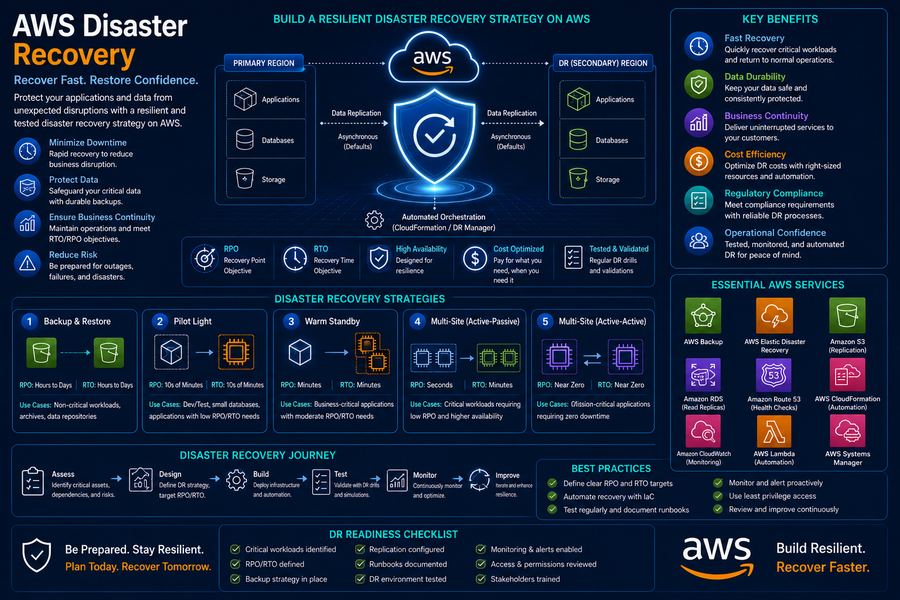
AWS Disaster Recovery (DR) is a set of strategies and tools that help organizations recover their applications and data in the event of a disaster. With AWS's global infrastructure, you can implement robust DR strategies that ensure business continuity and minimize downtime.
Understanding RTO & RPO
RTO & RPO Examples
- Mission Critical: RTO < 1 hour, RPO < 15 minutes
- Business Critical: RTO < 4 hours, RPO < 1 hour
- Non-Critical: RTO < 24 hours, RPO < 24 hours
Disaster Recovery Strategies
AWS offers four primary DR strategies, each with different RTO, RPO, and cost profiles:
Backup & Restore
Backup data and applications to S3 or other storage. Restore when needed.
Pilot Light
Minimal infrastructure running in DR region. Scale up on failure.
Warm Standby
Full infrastructure running in DR region, but scaled down.
Multi-Site Active-Active
Full production in multiple regions. Instant failover.
Backup & Restore Strategy
The Backup & Restore strategy is the most cost-effective DR approach, suitable for workloads that can tolerate longer recovery times.
Key Components
- AWS Backup: Centralized backup management
- Amazon S3: Data storage and archiving
- Amazon Glacier: Long-term archival storage
- Cross-Region Replication: Backup replication to another region
Best Practices
- ✅ Implement automated backup schedules
- ✅ Use cross-region replication for critical data
- ✅ Test restore procedures regularly
- ✅ Define retention policies based on compliance
Pilot Light Strategy
The Pilot Light strategy maintains a minimal version of your infrastructure in the DR region, which can be scaled up quickly during a disaster.
Key Components
- Database Replication: Continuous replication to DR region
- Core Infrastructure: Minimal compute resources in DR
- Auto Scaling: Configured to scale up on failover
- DNS Management: Route53 failover routing
Best Practices
- ✅ Keep core infrastructure running in DR region
- ✅ Automate failover procedures
- ✅ Test failover regularly
- ✅ Monitor replication health
Warm Standby Strategy
Warm Standby maintains a fully functional but scaled-down version of your production environment in the DR region.
Key Components
- Full Infrastructure: All components running at minimum scale
- Data Replication: Continuous data synchronization
- Auto Scaling: Configured to scale up on failover
- Load Balancers: Configured for failover
Best Practices
- ✅ Maintain minimum production scale in DR
- ✅ Automate failover and scale-up
- ✅ Test DR procedures monthly
- ✅ Monitor replication and latency
Multi-Site Active-Active
Multi-Site Active-Active strategy runs production workloads in multiple AWS regions simultaneously, providing near-instant failover.
Key Components
- Full Production: Active workloads in multiple regions
- Global Load Balancing: Route53 with health checks
- Data Synchronization: Multi-region database replication
- Zero Downtime: Instant failover capability
Best Practices
- ✅ Use AWS Global Accelerator for traffic management
- ✅ Implement multi-region database strategies
- ✅ Regular DR testing without downtime
- ✅ Monitor cross-region latency
Implementation Steps
Assess Workloads
Identify critical applications and define RTO/RPO requirements.
Choose DR Strategy
Select the appropriate DR strategy based on RTO/RPO and budget.
Design DR Architecture
Architect your DR solution using AWS best practices.
Implement & Test
Deploy DR infrastructure and conduct failover tests.
Monitor & Maintain
Continuously monitor DR readiness and perform regular tests.
AWS DR Tools
🔧 Recommended Tools
✅ DR Checklist
- ✅ Define RTO and RPO requirements
- ✅ Choose appropriate DR strategy
- ✅ Implement automated backups
- ✅ Set up cross-region replication
- ✅ Configure failover routing
- ✅ Document DR procedures
- ✅ Conduct regular DR tests
- ✅ Monitor DR readiness
At DeployInCloud, we help enterprises design and implement robust DR strategies on AWS. Contact us for a free DR assessment today.